Relationships
Safe and supportive relationships within the family and with other children and adults.
- A caregiver who listens
- A trusted teacher
- A neighbor who notices
- A peer who offers belonging
Find your place
You do not need to know which community you belong to. Choose the statement that sounds closest, and we will guide you from there.
Whatever shape your family takes, and whoever shares the work of care, there is room for you here.
For every person who shares in the life and care of a child.
For people who support families through programs, services, and community work.
For people studying the evidence, shaping systems, or learning alongside us.
From adversity to possibility
Conditions for thriving grow through connection, belonging, agency, healing, and opportunity.
Growing HOPE helps families, organizations, and communities put the Healthy Outcomes from Positive Experiences framework into practice. Together, we identify what is already strong, strengthen the relationships and environments that protect well-being, and create pathways for belonging, agency, healing, and opportunity.
The shared question
Adverse experiences help us understand what can cause harm. The Healthy Outcomes from Positive Experiences, or HOPE, framework helps us ask the next question:
What do people, families, and communities need in order to experience safety, connection, belonging, agency, healing, and opportunity?
HOPE is a strengths-based, flexible framework for prioritizing equitable access to positive childhood experiences. Growing HOPE helps translate that foundation into relationships, environments, policies, practices, and community systems.
Official HOPE key termsWhat Is HOPE?
Official HOPE foundationThe HOPE framework, developed through the HOPE National Resource Center and its research and practice base, centers key positive childhood experiences that help children grow into healthy, resilient adults and can lessen the effects of adversity.
Safe and supportive relationships within the family and with other children and adults.
Safe, equitable, and stable environments where children can live, learn, and play.
Opportunities for social and civic engagement that develop a sense of belonging and connectedness.
Opportunities for emotional growth where children feel supported through difficult events and emotions.
HOPE allows communities to hold two truths at once: people may experience real harm and hardship, and positive experiences can still be intentionally created, strengthened, and protected.
Already present
Every community contains people, traditions, spaces, relationships, and everyday practices that support well-being. Growing HOPE helps communities recognize, strengthen, and organize around the HOPE already present.
How the systems fit together
Kimberly MethodGrowing HOPE brings several bodies of knowledge into relationship without treating them as interchangeable. Each layer answers a different question, and together they help communities move from values to visible practice.
Name the relationships, environments, engagement, and emotional growth experiences people should be able to access.
What protective experiences are we growing?Begin with the positive that is real, present, measurable, and worth strengthening.
What is already working?Where a real misperception exists, test whether accurate local data changes it before scaling the message.
Which norm is misperceived, and how will we know?Treat families and community members as leaders, designers, researchers, and decision-makers.
Who already holds trust, knowledge, and capacity?See upstream conditions, downstream effects, stewardship, feedback, and interdependence.
What conditions shape the whole system?Translate the frameworks into tools, decisions, tests, implementation, learning, and shared ownership.
What will we build, try, learn, and sustain?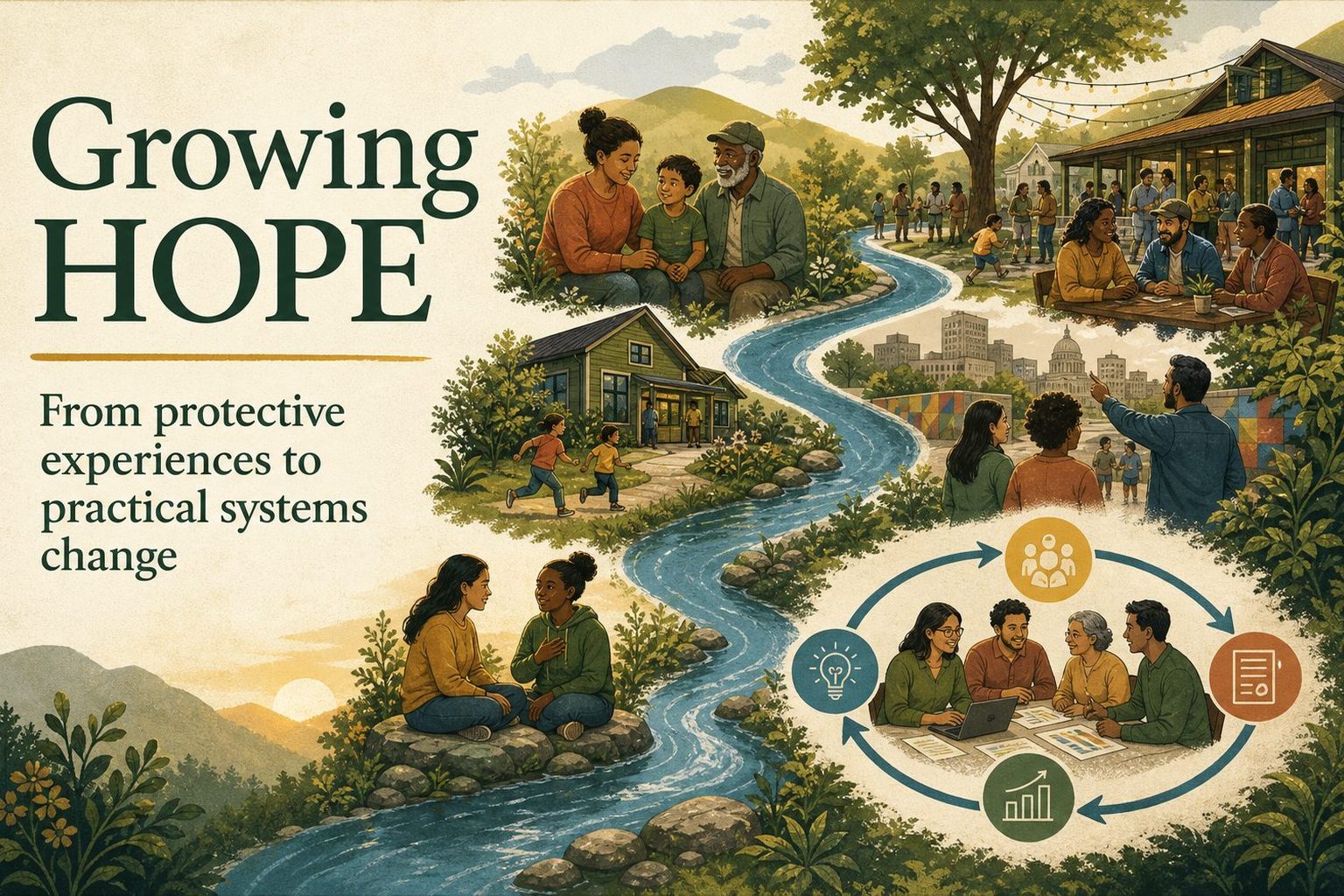
The Growing HOPE Approach
Kimberly MethodKimberly Ladd helps partners translate, integrate, and implement HOPE through listening, facilitation, strategic alignment, parent leadership, carefully tested social-norms strategies, evaluation, and long-term community infrastructure.
Begin with lived experience, community wisdom, stories, relationships, and local context.
Identify existing positive experiences, protective practices, community assets, and healthy norms.
Connect organizations, systems, partners, and resources around shared conditions for thriving.
Strengthen what is already working and create new opportunities for relationships, belonging, engagement, safety, and emotional growth.
Use reflection, stories, data, and community-led inquiry to understand what is changing.
Build leadership, shared ownership, policy alignment, local capacity, and long-term community infrastructure.
HOPE-informed organizational assessment, community conversations and listening circles, parent and family leadership, coalition development, tested social-norms strategies, storytelling, training and facilitation, strategic planning, partnership development, evaluation and community-led research, policy and practice alignment, and regional HOPE hubs.
From readiness to learning
Working HypothesisOfficial HOPE guidance describes a flexible framework that can inform individual, organizational, and community practice. Growing HOPE proposes this readiness path for shaping culture, planning, policy, program design, community engagement, and evaluation. It should be tested and adapted with real partners.
Build shared language around HOPE, existing strengths, and the change people want to make.
Notice readiness, internal culture, policies, relationships, community voice, and current assets.
Choose a specific audience and write a clear, inclusive, measurable aim.
Run the smallest useful test with defined roles, decision rights, and a visible next step.
Pair existing data with stories and feedback so measurement does not become a burden.
Document what changed, what traveled well, and what the community wants to sustain.
Measure what matters
Start with information people already collect. Pair numbers with lived experience and stories. Measure relationships, belonging, agency, access, participation, and protective conditions, not only problems. Use what is learned to improve the next test.
Individuals and Families
This is not a test, diagnosis, or measure of whether someone is a good parent. It is a reflective tool for noticing strengths, identifying unmet needs, and imagining possibilities.
Open the reflection toolThink of anyone who listens without judgment, checks in, helps with practical needs, or makes it easier to be yourself. One reliable person is a meaningful place to begin.
Belonging can grow at home, with friends, in a faith community, at school, at work, online, or in a neighborhood space where you feel welcomed and remembered.
Notice spaces that feel predictable, calm, accessible, and physically safe. A porch, library, park, familiar room, or community gathering place can all count.
Meaningful choice may be as simple as deciding how to spend time, asking for what you need, setting a boundary, or having a real voice in decisions that affect your family.
Consider the ways you share an idea, help a neighbor, care for someone, join a group, make something, advocate, volunteer, or bring lived experience to a decision.
Choose one experience that would make life feel more connected, steady, joyful, or possible. A small next step toward it is enough; this reflection is not a score or a judgment.
Look beyond stated values. Notice signage, language, privacy, accessibility, consistency, sensory comfort, and whether people can see themselves and their communities reflected in the space.
Ask where lived experience can change a decision, budget, policy, or program. Participation is more meaningful when people know their authority, are supported to contribute, and can see what changed.
Review one common policy from the perspective of the person most affected. Where can you offer transparent options, preserve dignity, explain the reason for a limit, or create a fair path for exceptions?
Alongside needs and risks, consider whether you can notice trusted relationships, belonging, participation, emotional support, access to safe places, and the choices people are able to make.
A referral can meet an immediate need. A warm introduction, peer connection, shared activity, or continuing relationship can also strengthen the social support that remains after a program ends.
Consider whether staff experience voice, belonging, psychological safety, supportive supervision, manageable expectations, opportunities to grow, and meaningful influence over the work they carry.
Organizations
Schools, nonprofits, healthcare providers, coalitions, government agencies, and community organizations can align services, policies, staff culture, and community engagement around the conditions that help people thrive.
Services may include HOPE orientation and training, assessment, strategic planning, facilitation, staff reflection, parent and community engagement, program crosswalks, policy review, evaluation planning, and implementation coaching.
Communities
A HOPE hub is a connected network of people and organizations that intentionally grows positive experiences across a place. It does not have to be a new building or standalone organization. It can be an organizing structure that helps existing partners align their work around common protective conditions.
Families, parent leaders, schools, childcare providers, healthcare providers, recovery organizations, prevention coalitions, parks, libraries, faith communities, local government, researchers, artists, businesses, youth, and elders all have a place in the ecosystem.
Areas of Work
Use HOPE to reduce isolation, strengthen relational health, elevate parent leadership, connect families to resources, and improve the environments surrounding pregnancy, birth, infancy, and early parenthood.
Support the relationships, environments, engagement opportunities, and emotional-development experiences that help children and caregivers thrive.
Move prevention beyond fear-based messaging and individual behavior change by strengthening belonging, connection, purpose, protective community conditions, and carefully tested norm messages.
Help rural communities recognize their assets, strengthen local leadership, connect fragmented resources, and create locally grounded solutions.
Support coalitions in moving from isolated programs to shared strategy, community ownership, and coordinated systems change.
Treat people with lived experience as partners, leaders, researchers, designers, and decision-makers, not merely recipients of services.
Help directories, helplines, and community access points connect people not only to services, but also to relationships, belonging, agency, and positive experiences.
Develop community-led research and evaluation practices that examine how HOPE is experienced, implemented, and sustained across families, organizations, and communities.
About Kimberly
Kimberly Ladd is a Tennessee-based community development and prevention leader, HOPE facilitator, HOPE Community Champion, coalition builder, strategist, and emerging community-led researcher.
Her work grew from lived experience as a mother navigating fragmented systems during her daughter's substance-use and pregnancy journey. That experience led her to convene community conversations, build a prevention coalition, and devote her work to understanding how families and communities create pathways toward healing and thriving.
Kimberly helps people hold the whole: to see the relationships between individual experience, family well-being, community conditions, organizational practices, and larger systems.
Kimberly's work is guided by the belief that communities are not empty vessels waiting for experts to fix them. They are living systems already filled with wisdom, relationships, culture, creativity, and possibility.
Growing HOPE Stories
Growing HOPE honors both.
Resources
Every destination now identifies its knowledge boundary, intended audience, source trail, and practical use.
View the full resource libraryWork With Us